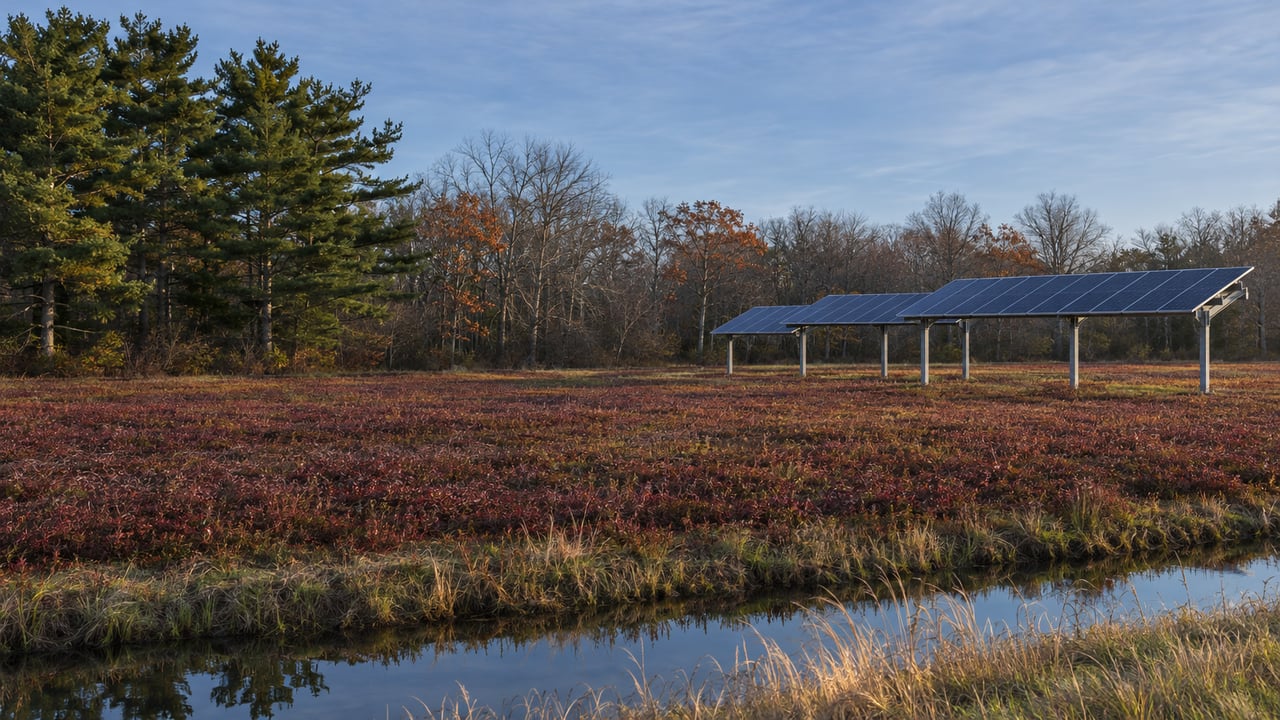
This fall, the harvest crews at 126 and 131–137 Ring Road worked around steel poles. As Canary Media described it, pickers in southeastern Massachusetts steered equipment through the shade of solar panels mounted ten feet overhead, at one of only two bogs in the country, and perhaps the world, where cranberries grow beneath a working solar installation. The other bog is just over the town line in Plymouth.
The panels are the reason the Ring Road bogs are being farmed at all.
Two bogs that had gone quiet
The Ring Road bogs and the Black Cat bogs in Plymouth had grown cranberries for decades. By the time the solar projects arrived, both had become financially unviable and had lain fallow for many years, according to the October 12, 2026 harvest announcement that Distributed Energy Infrastructure issued through PR Newswire.
Clean energy developer Greenbacker Renewables bought the land from growers who were ready to leave the business. Greenbacker then hired Iain Ward, a longtime cranberry farmer in the area who also works as a solar consultant, to run the growing operation. The project now goes by the name Ring Road Agrivoltaics Project. Ward earns money two ways: he is paid to manage the bogs, and he keeps the income from selling the crop.
The land itself explains why that arrangement matters. A retired hayfield or cornfield in Plymouth County can be sold to a housing or commercial developer. A cranberry bog cannot. Bogs are protected wetlands, and they stay unbuildable even after the farming stops. A fallow bog has no fallback use, so when the cranberry economics stop working, there is nothing else for it to become. Ward summed up the solar alternative in five words to Canary Media: "This is a farm viability opportunity."
Massachusetts grows more cranberries than any state except Wisconsin. For a town like Kingston, the question of what happens to bogs that stop paying is a practical one.
What a bog demands of a solar array
A standard ground-mounted array would have ruined the crop it sat on. Prateek Tare, co-founder and executive vice president of Distributed Energy Infrastructure, worked closely with Ward on the design. He told Canary Media the team was "trying to figure it out from a farmer's perspective." Several things had to change:
- Deeper foundations. Solar pilings usually go 8 to 10 feet into the ground. In a bog, crews had to drive them well past that to reach soil stable enough to hold them, and it took trial and error to find a machine that could do it.
- Overhead wiring. Cable could not be buried in wet bog soil, so it hangs overhead.
- Height and spacing. The panels sit ten feet up on axes that tilt to follow the sun through the day. The pilings are spaced farther apart than usual so harvesting equipment can move freely underneath.
- White mats in place of black ones. In Tare's account for North American Clean Energy, crews switched from black protective mats to white ones because the black mats soaked up too much heat for the cranberries.
Tare wrote in that same piece that construction took about eight months, around twice as long as a conventional project. The harvest that just finished was the second to come in from under the panels.
"If we can build over such challenging wetland areas and have successful harvests, we can build almost anywhere."
Iain Ward, in Distributed Energy Infrastructure's October 2026 harvest announcement
The numbers that keep the berries growing
The Ring Road array is rated at 4.4 megawatts and is paired with a 13.5-megawatt-hour battery. That battery is much larger than the one at Black Cat, which has a 1-megawatt array with 2.7 megawatt-hours of storage. Both projects sell their power through a community solar model. The developer describes them as supporting the state's SMART and Clean Peak Standard goals.
In 2018, Massachusetts became the first state to pay extra for solar built over working farmland. Under the current SMART 3.0 program, the state's Program Year 2026 schedule lists a base rate of $0.179 per kilowatt-hour for systems over 1,000 and up to 5,000 kW. It adds $0.09 per kilowatt-hour for qualifying dual-use agricultural projects. Set against that base rate, the farmland adder adds about half again as much.
On Ring Road, the money runs from the array to the farm. According to the developer, the land-lease income from the solar project is what made growing cranberries on these bogs economically viable again.
A paper trail at the Town House
Kingston's Conservation Commission has followed this project from the start. On August 11, 2021, the commission took up amendments to the Orders of Conditions for solar arrays over the cranberry bogs at 126 and 131–137 Ring Road. Water-quality monitoring and vegetative screening were part of that discussion.
Five years later the project was back on the agenda. The commission's August 12, 2026 meeting at the Town House on Evergreen Street listed requests for Certificates of Compliance for "construction of a dual-use agriculture and solar array system within existing cranberry bogs," continued from an earlier date. The same agenda included the Sampson Brook Restoration Project at Blackwater Memorial Forest and a land purchase at 83 Wapping Road. Commission meetings are carried by the Local Seen on Comcast 9 and Verizon 42 and streamed on the Kingston meetings YouTube channel.
What winter asks of these bogs next
With the berries off the vines, the regular bog calendar takes over. Here is what that calendar looks like, according to the Massachusetts Cranberries growers' association:
- Winter flood. Bogs are generally flooded from late December through mid-March, weather permitting, to protect the vines and buds. The association's water-use guidance says winter floods may start as early as December 1 and generally end no later than March 15.
- Sanding. Every few years growers spread sand to help growth, drainage and pest control. One method is to lay the sand on the ice that forms over the winter flood.
- Frost protection. In spring and fall, growers may run sprinklers to protect the plants from frost.
The UMass Cranberry Station explains that winter floods protect vines when winterkill conditions are expected, and that the water should ideally be deep enough to cover the vine tips. At Ring Road, the bog's flooding cycle was one of the things the design team planned around before any piling went in. This winter, the ice will form among the poles of a 4.4-megawatt array.
Ring Road as the template
Kingston is now the reference case for a growing pipeline. According to Canary Media, the Kingston and Plymouth sites have brought Tare's company more agrivoltaic work, including arrays in apple orchards, on a cattle pasture and on a Christmas tree farm. Preliminary work has also started at another bog.
In Carver, two other bogs were set five years ago to become the nation's first cranberry agrivoltaic sites. The arrays went up and crops are growing beneath them, but the company behind them went bankrupt before they started operating. Ward told Canary Media that the bogs' new owner has "every intention to finish them." Both the Ring Road and Black Cat projects were finalists for the North American Agrivoltaics Awards. Ward and Distributed Energy Infrastructure are both founding members of the Solar & Farming Association.
"When you change a paradigm, it takes a little time," Ward told Canary Media. On Ring Road, the bogs are now two harvests into that change and headed for their winter flood.
The bogs, woods and brooks on that Conservation Commission agenda are the setting many Kingston homes sit in. If you're thinking about how your own Kingston or Duxbury home's setting and history should come through in its marketing, Regan Peterman would be glad to talk it through over a private consultation.